STANDALONE CLONE
Independent aircraft package installed
After correcting the one-click title parser, installer V3 created a separate X-90T aircraft without modifying the original Black Square installation.
From a refined 500-SHP PT6-class Bonanza to a speculative 3,000-SHP research platform. The engine is easy to turn up; making the propeller agree is the real program.

The Black Square B36TP is a purpose-modeled turbine variant with a dedicated cockpit, engine simulation and propeller behavior.
The stock B36TP in Bonanza Professional models a 500-SHP Pratt & Whitney PT6A-21, driving an 84-inch four-blade Hartzell constant-speed, reversible propeller.
The published manual lists 124 US gallons of Jet-A total fuel capacity. It has dedicated controls for torque, ITT, gas-generator speed, turbine ignition and propeller management.
See the official Black Square aircraft ↗An ambitious V1 uncovered the limits of increasing power without matching the governor, prop load, fueling and control response.
After correcting the one-click title parser, installer V3 created a separate X-90T aircraft without modifying the original Black Square installation.
Torque ceiling, modeled fuel delivery, ITT damage thresholds and custom engine logic were altered. The four-blade prop and basic governor were initially retained.
The pilot reported roughly 1,000 FPM climb, sluggish controls, indicated torque over 2,500, ITT above 850°C, prop RPM around 3,500, and a governor that did not regulate properly. These are reported, unverified simulator observations.
Reworked blade-pitch time constant and governor PID, broadened the simulated blade chord, enabled prop absorbed-torque feedback, reduced torque runaway and added experimental fuel-command limiting.
V2 has been packaged, but flight-test results have not yet been reported. Delivered 3,000 SHP remains a research goal, not a demonstrated fact.
The status of the turbine program today, without mixing targets and flight-test results.
Nominal rating in the mod. The engine/prop model has not demonstrated a steady delivered 3,000 SHP.
Reported in the initial V1 test; altitude, gross weight and other test conditions were not logged.
Reported overspeed and a nonfunctional governor. V2 aims to recover speed control.
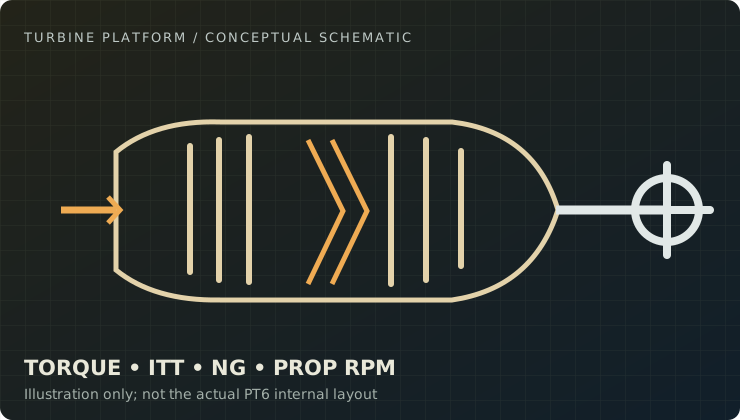
V2 works across the engine torque table, turbine fuel command, propeller absorbed-load feedback and pitch-governor response rather than treating rated horsepower as a single magic number.

V1 rescaled the cockpit torque indication to one third of modeled torque. The printed dial is not a reliable real-world limit.
850°C sustained-damage threshold is a fictional experimental setting. V1 exceeded it; V2 fuel limiting has not yet been verified.
V2 modifies the modeled blade behavior, not the original four-blade 3D propeller. An actual high-Mach propfan would require an entirely new design.
Selected changes from the installed V1 baseline to the unverified V2 test build.
| SYSTEM | V1 | V2 |
|---|---|---|
| Nominal shaft power | 3,000 SHP | 3,000 SHP (same target) |
| Hard shaft-torque cap | 7,500 ft-lb | 7,200 ft-lb |
| Prop pitch response constant | 0.075 | 0.80 |
| Governor PID (P/I/D) | 5 / 3 / 15 | 13 / 3 / 8 |
| Max modeled blade pitch | 59.5° | 68° |
| Simulated blade aspect ratio | 7.0 | 4.5 |
| Prop absorbed-torque feedback | Off | On |
| High/max fuel flow parameter | 1,350 lb/hr | 1,250 lb/hr |
| Flight-control elasticity | Stock | Modestly higher authority |
| 3D prop / fuel tanks | Four-blade / stock | Still four-blade / stock |
The longer-term X-90T idea is a geared, high-speed propfan-style research aircraft. Advanced propellers can operate near transonic aircraft speeds, but the Bonanza airframe, wing, tail, propeller, and structural assumptions would need wholesale redesign in reality.
For now the priority is simple: make the existing four-blade model fly properly before expanding the simulated speed envelope.
Turbine modding FAQ ↗