ENGINEERING BUREAU / TECHNICAL STUDY 01

BEYOND THE SIMULATOR.

What would it take to turn the X-90P and X-90T concepts into actual flying prototypes? A preliminary engineering study in propulsion, structures, certification, flight testing and program economics.

ISSUE 01 / NOV 2026 • 2026 US DOLLARS • CONCEPT PLANNING ONLY
00 / BASIS OF ESTIMATE

SIMULATED PERFORMANCE IS NOT AIRWORTHINESS.

These are high-level, bottom-up planning allowances for a one-off experimental research demonstrator, not bids, vendor quotations, STC estimates, or promises of technical feasibility.

One prototypeDesign, fabricate, instrument and flight-test
$180–$280/hIllustrative burdened engineering labor assumption
30–40%Allowances for rework, program integration and risk included in ranges
2026 USDNo production line or formal type-certification guarantee
CONVERSION REALITY

Aircraft identification may survive; the structure may not.

A 1,500 HP piston engine or 3,000 SHP turbine would create radically different loads, temperatures, vibration spectra and flight envelopes. The baseline Bonanza's design margins cannot be assumed to scale with power. A thorough feasibility review could conclude the practical solution is a new airframe with Bonanza styling.

For a type-certificated aircraft, major changes ordinarily require substantial substantiation and an STC or type-design approval; the FAA may require a new type certificate if the change is sufficiently extensive.

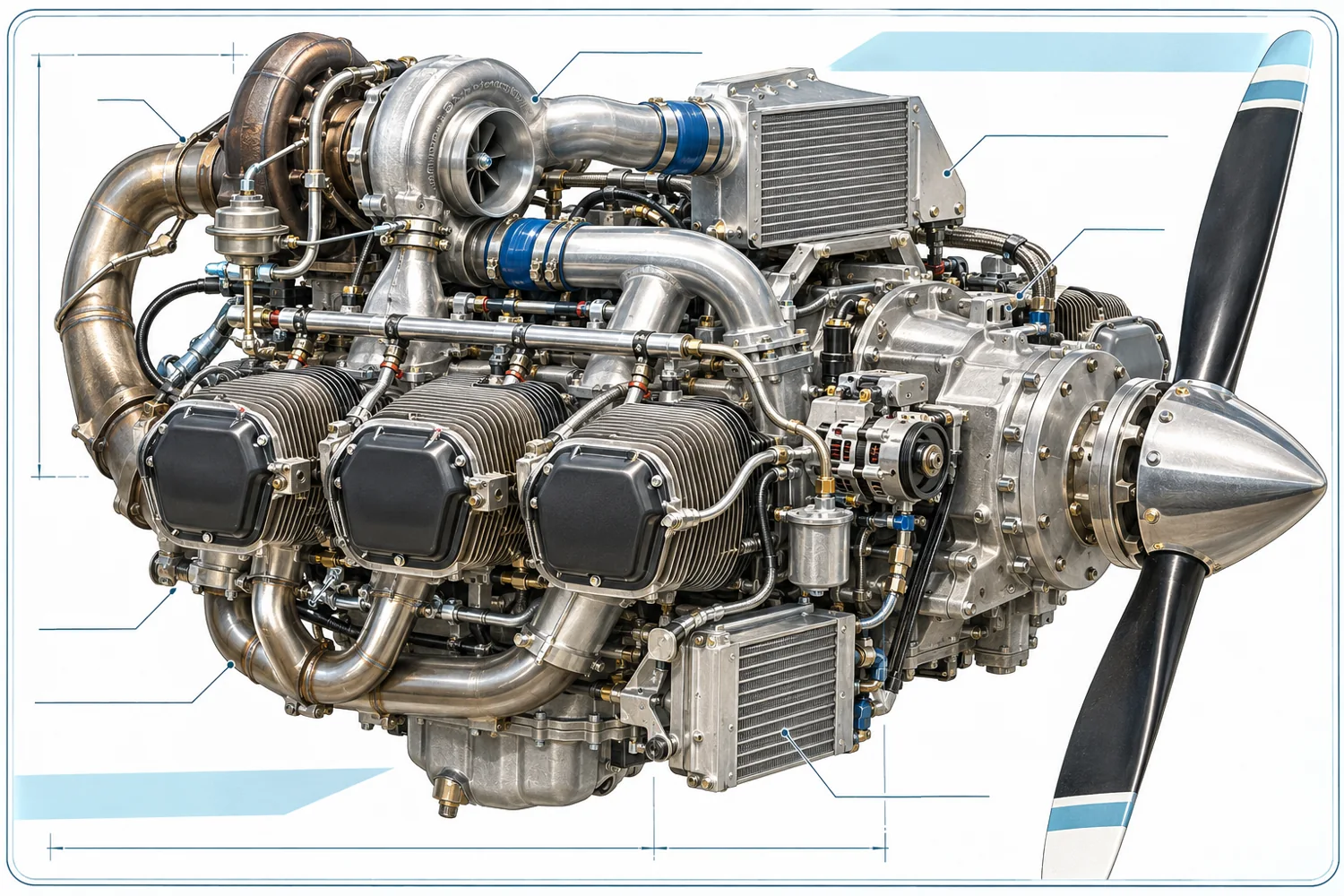
High-detail conceptual experimental turbocharged flat-six piston engineILLUSTRATIVE POWERPLANT CONCEPT / NOT A REAL ENGINE AVAILABLE FOR PURCHASE
01 / PISTON PROGRAM

X-90P / 1,500 HP PISTON.

A radical bespoke high-boost piston installation. The challenge is not making a familiar six-cylinder engine produce 1,500 HP for seconds; it is delivering repeatable shaft power for hundreds of hours without destroying the engine or airframe.

01 / THERMODYNAMICS

Combustion & turbocharging

A clean-sheet bottom end, cylinder and head metallurgy, detonation margin, charge-air cooling, compressor maps, pressure ratio and turbocharger overspeed analysis. At 45 inHg, knock and thermal loads become dominant; 1,500 HP cannot be validated by manifold pressure alone.
02 / ROTATING ASSEMBLY

Propeller & torsional dynamics

Crankshaft fatigue, torsional resonance, reduction gearing if required, blade centrifugal stress, propeller ground clearance, governor transient response and spinner/nacelle drag. An existing Bonanza propeller is not rated for this torque.

03 / AIRFRAME

Structure and mass properties

Firewall and engine mount redesign, wing spar and attachment substantiation, V-tail aeroelastic and flutter analysis, landing gear load cases, revised CG travel and a new weight-and-balance envelope. Six hundred gallons of avgas is approximately 3,600 lb before pilot and payload.

04 / TEST OPERATIONS

Ground-to-flight progression

Instrumented dyno endurance, propeller vibration survey, thermal mapping, taxi tests, low-power first flight, progressive climbs and handling, flight flutter clearance, then flight-manual expansion. Inspections and engine teardown intervals must be established empirically.

PISTON / BUDGET ESTIMATE

Development allocation

One-off research demonstrator, preliminary estimate. Assumes original engine family is largely replaced by a bespoke powerplant design, with substantial unproven airframe work.

$6.9–18.8M indicative R&D

Schedule: 3–6 years from feasibility study through iterative flight testing, assuming a viable path exists. Formal approval and production could cost much more.

Work packageLowHigh
Powerplant: bespoke 1,500 HP piston development$2.0M$5.0M
Propeller, governor and drivetrain$0.7M$1.8M
Primary structure, mounts and flutter analysis$0.8M$2.4M
Turbo, fuel, cooling and tank structure$0.7M$1.9M
Aerodynamics and stability engineering$0.6M$1.8M
Instrumentation, avionics and test telemetry$0.3M$0.8M
Ground testing and experimental flight program$0.8M$2.1M
Program integration, reserve and rework$1.0M$3.0M
Notional R&D total$6.9M$18.8M
02 / TURBINE PROGRAM

X-90T / 3,000 SHP AMBITION.

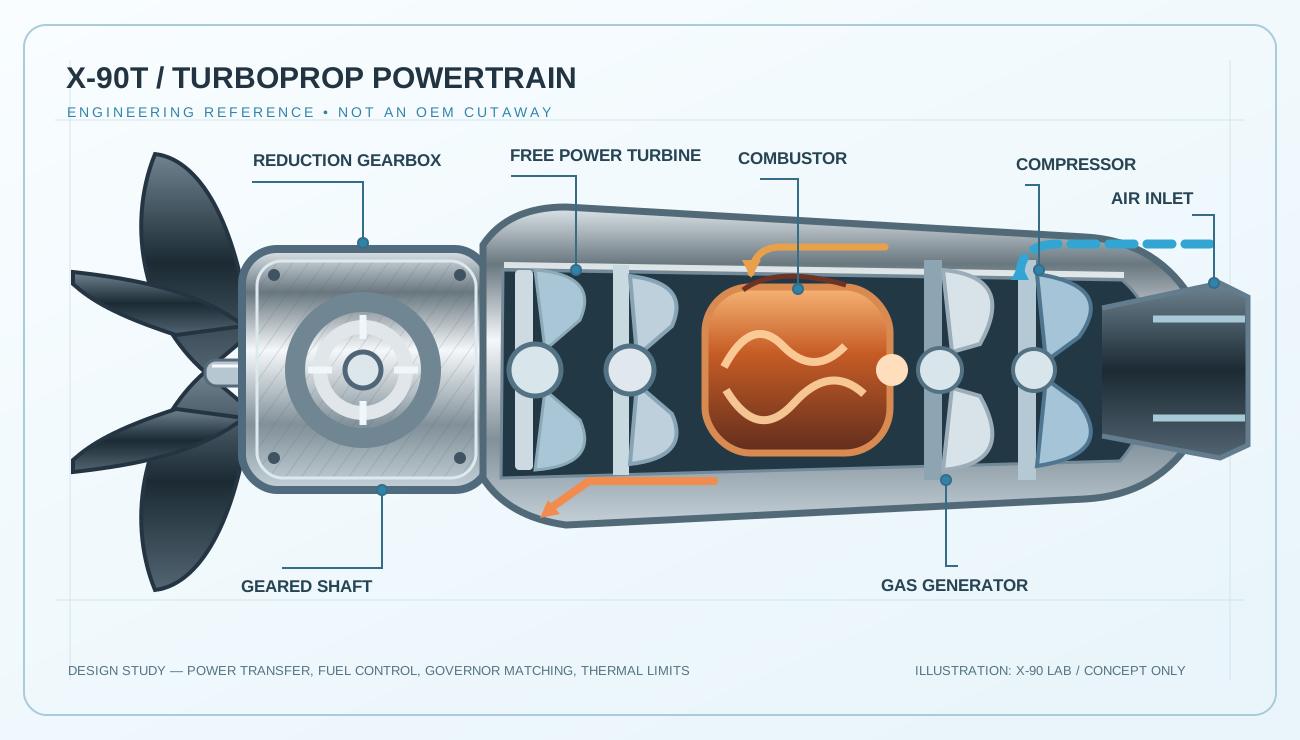
A much more plausible powerplant class than a 1,500 HP piston, but grossly beyond the stock 500 SHP A36TP installation. A 3,000 SHP free-turbine system would demand a different engine, reduction gearbox, propeller and likely structural architecture.

Detailed conceptual turboprop cross-section showing gearbox, power turbine, combustor and compressorCONCEPTUAL SECTION / NOT A PT6 OEM DRAWING
WHERE THE ENERGY GOES

Engine power, propeller absorption, thrust.

Core output alone cannot create speed. The power turbine, reduction gear, propeller aerodynamic loading, pitch scheduling and nozzle/installation losses must remain balanced. In the simulator, our V1–V3 program showed governor overspeed, heat exceedances and even negative acceleration with more throttle. A real program would stop flight testing and conduct instrumented ground investigations.

01 / PROPULSION

Free turbine / gearbox

Choose a 3,000 SHP-class engine, design hard-point load paths, gear reduction, oil cooling, exhaust isolation and propeller control. A conventional 84-inch four-blade prop is not a credible 3,000 SHP solution.

02 / PROPELLER

High-disk-loading propfan

Blade number, swept planform, compressibility, helical tip Mach, torsional fatigue, gearbox torque reversals, acoustic signature and nacelle flow. NASA demonstrated specialized swept propellers near Mach 0.80, not a conventional Bonanza prop.

03 / STRUCTURES

Mach, stability and flutter

New wing section, compression drag, tail loads, pitch stability, control-surface hinge moments, flutter clearance and structural fatigue. Mach 0.75–0.80 would probably entail effectively a new aircraft, regardless of external resemblance.

04 / SYSTEMS

Fuel, heat and handling

Six hundred gallons of Jet-A weighs roughly 4,020 lb. Re-engineering the wing center section, cabin floor, pressure vessel concept, environmental systems, fire protection and active torque compensation becomes central to a feasible aircraft.

TURBINE / BUDGET ESTIMATE

Development allocation

One-off research demonstrator with new drivetrain and major structural changes. A Mach 0.80 variant could require a clean-sheet program well above this range.

$13.9–39.7M indicative R&D

Schedule: 4–8 years for the experimental prototype, conditional on engine and structural feasibility. A certificated Mach 0.8 transport-class research effort may enter an entirely different cost bracket.

Work packageLowHigh
High-output turbine engine and installation$2.0M$5.0M
Gearbox, propeller / propfan development$2.5M$7.0M
Wing, fuselage, tail, mounts and aeroelasticity$2.8M$8.0M
Fuel system and expanded tank structure$0.6M$2.0M
CFD, wind tunnel and propulsion integration$1.6M$5.0M
Control, instrumentation and avionics$0.6M$1.7M
Ground, taxi, propeller and flight testing$1.8M$5.0M
Program management, compliance planning and reserve$2.0M$6.0M
Notional R&D total$13.9M$39.7M
03 / DEVELOPMENT GATES

ENGINEERING RELEASE CRITERIA.

Disciplined configuration control is the difference between collecting interesting numbers and conducting a flight-test program.

G0

Feasibility & loads

Requirements, credible performance model, preliminary CG, V-n envelope, airworthiness plan and safety assessment.

G1

Bench & ground

Dyno / torque trace, fuel and ITT/N1 behavior, propeller blade-pitch feedback, vibration, brakes and taxi controllability.

G2

Low-risk first flight

Conservative thrust, climb margin, engine-out handling assessment, controllability and landing performance.

G3

Envelope expansion

Incremental IAS, Mach and altitude clearance, flutter testing, performance correction and aircraft flight manual data.

G4

Durability

Endurance demonstrations, inspections, continued-airworthiness limits and repeatability across sorties.

Regulatory and technical references

FAA materials describe STC substantiation and flight-test processes; NASA's advanced propfan research demonstrates why high-Mach propeller flight needs a specialized design.